Cultivating Sustainable Futures Through Science, Empowerment & Ecological Synergy
Stichting ARELIS
APICULTURE & AGRICULTURE RESEARCH & LEARNING INSTITUTE
Welcome to ARELIS
Apiculture & Agriculture Research & Learning Institute in Suriname.
As an ambitious and growing NGO (operational since 2024), Stichting ARELIS bridges empirical research, traditional ecological knowledge, and sustainable economic development. As a young research and learning institute, we combine scientific insights—focusing on soil health, phytosanitary crop resilience, and climate-smart agroforestry—with hands-on community engagement. By championing local entrepreneurship, apiculture education, regenerative farming, and female empowerment initiatives like the Sisa Business Network, we transform environmental stewardship into community resilience. Together with Indigenous and Maroon communities, national ministries, scientific partners, and international donors, we pave the way for a resilient, equitable, and sustainable Suriname.
"Through innovative solutions, social inclusion and collaborative efforts, we strive to create a world where nature thrives, and every voice is valued in building a resilient, equitable planet."
Stichting ARELIS (Apiculture & Agriculture Research & Learning Institute in Suriname) is a registered, fast-growing NGO founded on March 4, 2016. Based in Wanica, we bridge the gap between traditional community wisdom and scientific research to drive sustainable development across rural and interior Suriname.
Our Mission:
The core purpose of ARELIS is to empower communities in rural areas through innovative, ecological farming methods. We believe that sustainable practices not only deliver economic benefits—such as higher yields and increased agricultural income—but also contribute to climate adaptation and the preservation of our forests and ecosystems. By combining local knowledge with scientific insights, we aim to create a model that is scalable and can be replicated in other villages. Ultimately, we strive for a future in which Surinamese farmers can produce independently, resiliently, and in harmony with nature, with a strong focus on the active inclusion of wo(men), youth, and Indigenous and Maroon communities.
What we do
Building sustainable communities through innovation and collaboration.
04 AREAS OF FOCUS
01
Socio-Economic & Ecological Impact Driving Sustainable Livelihoods, Soil Restoration, and Community Resilience Across Suriname
1. Regenerative Agriculture & Apiculture.
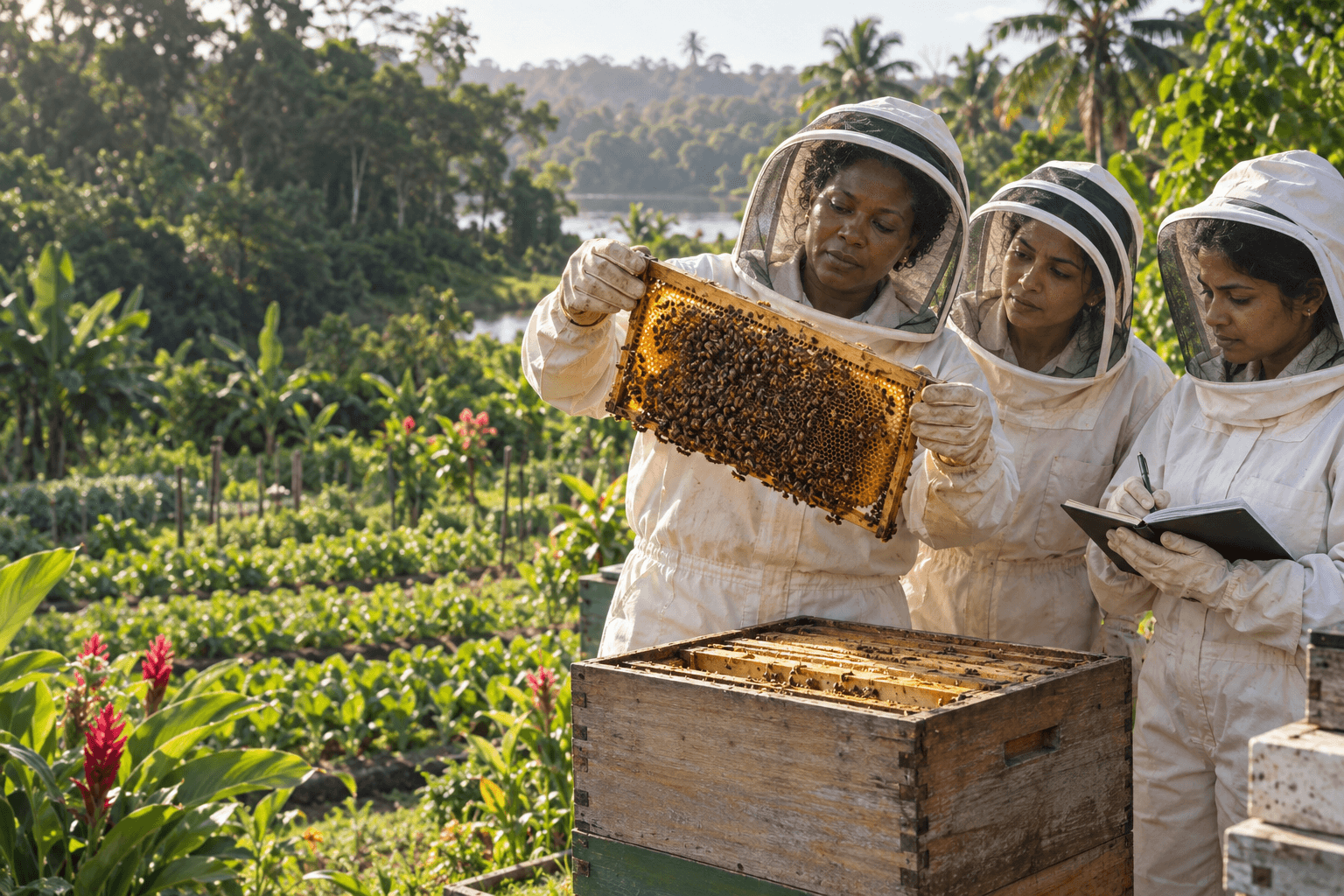
At ARELIS, we go beyond sustainability to actively restore and revitalize our ecosystems. By transitioning communities away from soil-depleting slash-and-burn practices towards regenerative agroforestry and permaculture, we rebuild degraded soils, protect the Amazonian rainforest, and enhance biodiversity. Soil Regeneration & Health: We train farmers in organic composting, biological soil enrichment, and chemical-free crop management to restore vital nutrients, combat plant diseases (such as Cassava Wiches Broom Disease), and guarantee long-term food security. Pollination & Forest Health: Integrated apiculture utilizes bees as natural ecological engines—enhancing crop yields through pollination, serving as bio-indicators for rainforest vitality, and creating certified, eco-friendly honey value chains.
2. Research, Capacity Building & Leadership. We bridge empirical research with traditional ecological wisdom to provide inclusive, hands-on learning experiences for rural communities. Scientific & Applied Learning: Partnering with academic institutes and agricultural experts, we deliver certified training programs in regenerative farming techniques, nursery management, and crop diversification. Inclusive Empowerment: We equip women, youth, and rural entrepreneurs with technical expertise, leadership tools, and business development skills (including the Sisa Business Network) to foster self-reliance and community governance.
3. Market Access, Visibility & Value Creation. Sustainable practices must lead to viable economic autonomy for interior and rural families. Green Income Streams: By developing high-value sustainable supply chains (such as cacao agroforestry, honey, and short-cycle food crops), we create secondary income streams that protect the forest. Fair Platforms & Market Visibility: We facilitate empowerment fairs, networking events, and direct market platforms that connect local producers with domestic and international buyers, eliminating barriers and ensuring fair economic returns.
Our Philosophy: The Harmony of Complementarity.
At ARELIS, gender responsiveness is built on the fundamental principle of equipotentiality and ecological synergy. We view men and women as equals in value and dignity, without elevating one above the other. Practical experience in community development has taught us that sustainable progress relies on a harmonious balance—recognizing, respecting, and leveraging the unique strengths, inherent gifts, and traditional wisdom that every individual brings to the community. Just as in nature, where two distinct forces interweave to sustain life and foster growth—like the sun and the soil, or pollinators and blossoms—men and women form an inseparable unit in community resilience.
Why We Write "Wo(Men)" Our choice to write Wo(Men) is intentional. It visually and semantically captures unity: Men is embedded within Women, symbolizing that true empowerment does not divide, but unites. It reflects an inclusive vision where women’s leadership is cultivated not in opposition to men, but in partnership with them, creating a balanced social ecosystem for future generations. Core Pillars of Action Synergistic Leadership Development: Fostering leadership programs that build confidence, public speaking, and strategic vision for women & men, while honoring cooperative community governance. Capacity & Cooperative Management: Equipping women, men and youth with technical, financial, and organizational tools (such as through the Sisa Business Network) to lead thriving, sustainable enterprises.
Youth Mentorship & Intergenerational Continuity: Training youth as the seeds of the future, blending scientific innovation with inherited cultural ecological knowledge to secure long-term leadership.
02
03
Networking, Regional Integration & Academic Collaboration: Building Transboundary Bridges for Knowledge Sharing, Innovation, and Sustainable Development
Cross-Border Knowledge Exchange & Strategic Alliances. ARELIS actively builds bridges across international borders to facilitate collaborative development, policy alignment, and ecological research. We connect Surinamese rural communities with regional and global networks across the Caribbean, French Guiana, the Netherlands, and Canada.
Transboundary & Regional Partnerships: Through platforms in French Guiana, the Caribbean Biodiversity Fund, the French Embassy, Green Heritage Fund Suriname and Canadian partnership funds, we exchange best practices in cacao agroforestry, cassava resilience, and pollinator conservation.
Integrated Ecological Solutions: By sharing scientific insights and traditional wisdom across borders, we strengthen climate resilience and community development throughout the Guiana Shield and the broader Caribbean.
2. Academic & Student-Led Innovation
We foster a dynamic learning ecosystem that connects students, independent researchers, and academic institutions directly with field projects in rural communities.
Fresh Perspectives & Cutting-Edge Research: experts and reseachers from the Ministry of Agriculture, students and young researchers bring digital literacy, scientific methodologies (including soil science and phytosanitary research), and creative problem-solving that help modernize rural business models and ecological practices.
Mutual Growth & Capacity Building: While students gain invaluable, real-world field experience in project management, agroforestry, and community-driven research, our programs benefit from vital operational energy and research-backed data.
3. Securing Long-Term Impact & Future Leadership Sustainability requires intergenerational continuity. By engaging scientists, youth, students, and local community members in international knowledge networks today, we cultivate socially conscious leaders, researchers, and ethical entrepreneurs who will carry the torch of ecological stewardship and community empowerment into the future.
03
04
Sustainable Projects Through Cultural Preservation & Social Inclusion: Bridging Ancestral Ecological Wisdom with Nature-Based Climate Solutions
At Stichting ARELIS, we believe true sustainability is inseparable from cultural identity and the active inclusion of all community members. We safeguard and document the traditional ecological knowledge of Indigenous and Maroon communities, weaving ancestral wisdom into modern climate strategies. Documentation of Traditional Heritage:
Preserving, documenting, and transmitting ancestral farming techniques, indigenous crops, and cultural practices for future generations. This prevents cultural erosion and strengthens community pride and self-reliance. Climate Resilience & Ecosystem-Based Adaptation (EbA):
Developing climate-resilient ecosystems through nature-based solutions and adaptive strategies. By bridging traditional ecological knowledge with scientific research, we build long-term climate resilience across Suriname's interior. Social Inclusion & Shared Value Creation:
Engaging all community segments—including women, youth, and village leaders—directly in project management and decision-making, ensuring that every voice is valued in building a resilient, equitable planet.
04
From Grassroots Passion to a Thriving Institute
Driven by Passion, Anchored in Science, Committed to Sustainable Impact
ARELISGROWING STRONG TOGETHER
01
The ARELIS Journey
The Story of our Founder:
The foundation of Stichting ARELIS was born out of a profound passion for community development and a deep respect for nature. After completing her law degree, founder Shivangi Vermeijs-Mahabali dedicated her early career to internships and field projects focused on interior development and economic empowerment, particularly for rural and hinterland women. As a passionate beekeeper, her hands-on work with nature opened new doors. Through continuous study, scientific research, and practical exploration, she discovered the powerful connection between a wholesome life, healthy nutrition and living in harmony with natural ecosystems.
A Vision for Structural Change
Visiting inland and rural villages, Shivangi observed a persistent pattern: despite years of short-term project investments, communities were often left without the tools for long-term, self-sustaining progress. Driven by conversations with village elders, women, and residents, she realized that temporary solutions were not enough. Suriname needed a structural approach—one that bridges scientific innovation with traditional wisdom to build lasting resilience.
From Foundation to Action
While Stichting ARELIS was legally established in 2016, its operational journey took a pivotal step forward in 2024, following Shivangi’s return from a period in Europe. Equipped with fresh perspectives, international insights, and renewed energy, she activated ARELIS not just as a project initiative, but as a dedicated Research & Learning Institute. Today, together with a passionate team of experts, donors, organisations, researchers, and village leaders, ARELIS works every day to turn this vision into reality—sowing seeds for a sustainable, resilient, and empowered Suriname.
02
Strategic Networking
We connect local action to global impact: Regional partners: French Guiana, Caribbean, Canada; Academic partners: ADEK University; Government partners: Ministry of Agriculture; Diaspora networks: Cultural & economic exchange; Annual knowledge-sharing seminars.
Our Impact
Growing Strong with Arelis. Together, we are making a difference.
01 October 2024-October 2026
Participants
79 male and female farmers, women entrepeneurs and youth trained in leadership costprice calculation, sustainable agriculture and agroforestry.
02 2026
Research & Learning
Collaboration established with entities such as the Ministry of Agriculture, Livestock, and Fisheries, French Embassy, Bureau dienstverlening aan NGO's (BFN), Tropenbos Suriname, researchers, and volunteers.
03
Impact
Introduction of cacao cultivation and fast-growing crops (cassava, banana, pineapple) increased food security and created income opportunities. Traditional knowledge documented and shared through workshops, contributing to cultural preservation (SDG 1, 5, 15).
04 October 2024 - october 2026
Bernardorp, Cabendadorp & Wan Hatti
In collaboration with the Ministry of Agriculture, Livestock, and Fisheries, we organized weekly training sessions for Indigenous & Maroon male & female farmers in sustainable agriculture techniques, making compost, focusing on cultivating native crops such as cassava, pineapple, and leafy greens without pesticides or synthetic fertilizers.
05 May 2026 - October 2026
Wan Hati: Preserving Cultural Heritage trough Beekeeping, agroforestry and social inclusion
Expansion of the Growing Strong project through cacao farming and beekeeping in Wan Hatti. Following the successful pilot supported by the French Embassy, the project continues with new donors CORE, Canada Fund and Green Heritage Fund Suriname (GHFS). In collaboration with these partners and The Golden Honey Bee, training is provided in agroforestry (including cacao cultivation), permaculture and beekeeping to at least 15 women,youth and men. The training integrates traditional Indigenous and Maroon crop cultivation practices with modern regenerative techniques. Through agroforestry, permaculture and beekeeping we enhance biodiversity, strengthen climate resilience and support sustainable livelihoods.
06
Cultural Heritage & Women empowerment
The chairperson participated in a workshop by Hess International and Counterpart Women, receiving training in community investment and economic growth. This led to the establishment of a platform for female entrepreneurs. September 2025 - Networking Event: Organization of an initial networking event with 10 women and 2 youth to develop their business model canvas, focusing on economic empowerment. led to the establishment of a platform for female entrepreneurs.
Acknowledgements
With deep gratitude, we reflect on a successful first operational year of Stichting Arelis. Together growing strong, we are moving ahead, bringing lasting impact and sustaining resilient communities, thriving ecosystems, and hope for generations to come.
Our mission to drive sustainable change for Indigenous and Maroon communities is only possible thanks to the unwavering support of many.
01
Our Team
Thanks to the great team who believed in Arelis' vision to establish an organization advocating for the interests of Indigenous peoples, Maroons, and women. At Stichting ARELIS, impact is born from collaboration. Our operational strength relies on a unique, interconnected ecosystem where international diplomacy, scientific rigor, and next-generation academic talent converge into a single mission: driving sustainable development and community empowerment across Suriname.
02
The Golden Honey Bee
Our vital, long-standing partner in advancing sustainable beekeeping, pollinator-friendly practices, and honey value chains, amplifying our shared impact across communities. Our first community projects started within The Golden Honey Bee. This essential partnership provides Stichting ARELIS with the official regulatory backing, national network, and specialized beekeeping expertise required to execute our community programs safely and effectively.
03
Governmental & National Bodies, Local Communities & Village Leaders:
The Ministry of Agriculture, Livestock, and Fisheries (LVV), the Office of the President, the District Commissioner's Office, and the Bureau for NGO Services (BFN) for their structural guidance and providing technical expertise. Local Communities & Village Leaders: The Captains, village councils, and local residents of Wan Hatti, Bernardorp, and Cabendadorp, whose trust and full cooperation make our field projects possible.
04
French Embassy.
Thanks to the French Embassy in St. Lucia and the French Ambassador in Suriname, who were among the first to literally sow seeds in our first project in collaboration with The Golden Honey Bee. Our collective team brings together the strategic patronage of the French Embassy, providing the vital institutional backing and international resources needed to scale our regional initiatives. This global support is seamlessly integrated with the intellectual drive of expert Researchers and ambitious Students from the Anton de Kom Universiteit van Suriname (AdeKUS). Working hand-in-hand, our academic pioneers supply the scientific data and innovative frameworks, while AdeKUS students transform this knowledge into active field research, community outreach, and grassroots execution. Together, this powerful alliance ensures our programs are sophisticated, data-driven, and built for generational impact.
05
International Partners & Donors
The French Embassy, GEF-SGP Suriname / UNDP, Canada FUND, the Caribbean Biodiversity Fund (CORE) and Green Heritage Fund for their critical funding and strategic support during our startup and growth phases.
06
Our Team, Volunteers & Women Leaders:
Our dedicated board, trainers, volunteers who supported ARELIS in this growth phase, wo(men) and youth whose passion, resilience, and teamwork breathe life into ARELIS every day.
TAKE ACTION
Join Us In Making A Difference and Let's Grow Strong Together